The Vending Industry in 2026
⏱ 8 min read
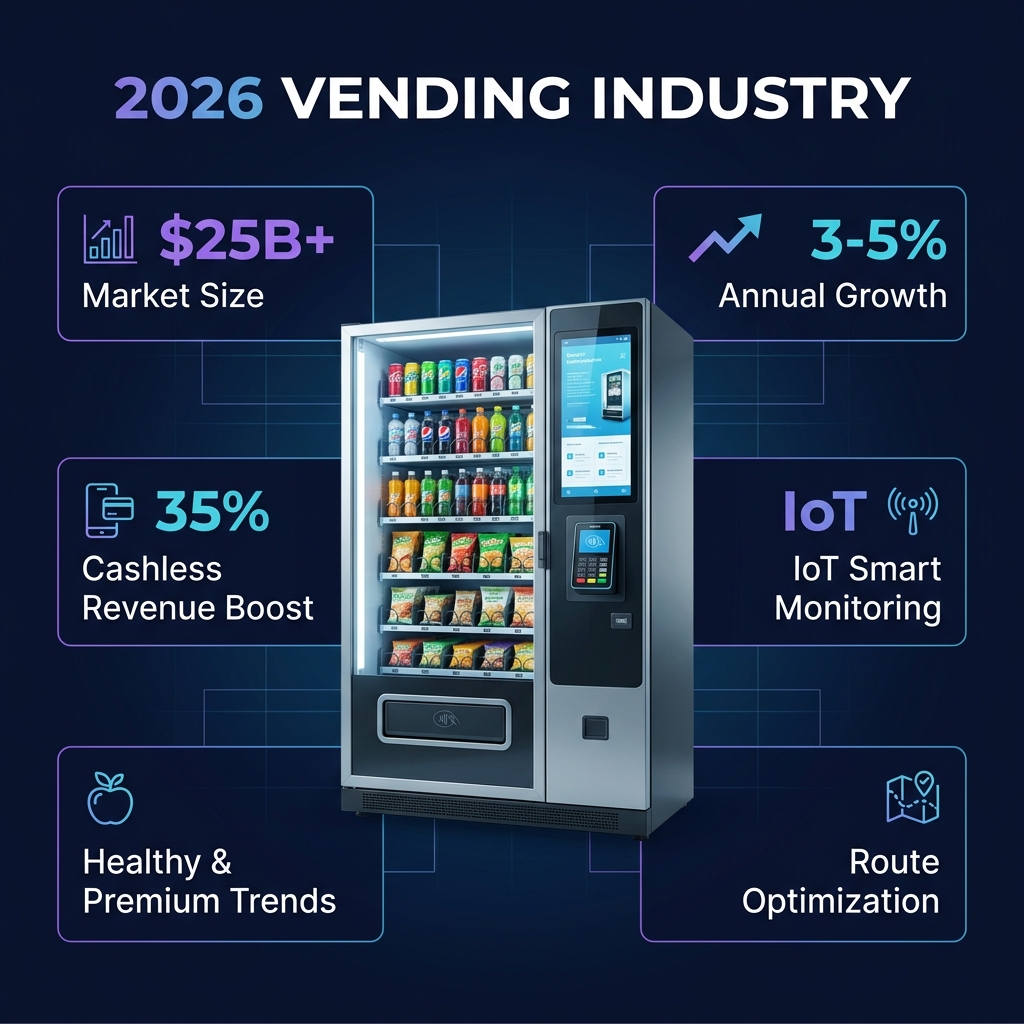
The modern vending industry: $25B+ market powered by cashless payments, IoT monitoring, and healthy consumer trends.
The Vending Industry in 2026: Market Landscape and Opportunities
The automated retail industry is undergoing a massive structural transformation. In 2026, vending is no longer just about dusty, mechanical machines dispensing stale potato chips and high-fructose corn syrup sodas. It has evolved into a multi-billion dollar sector powered by IoT connectivity, cashless mobile payments, real-time telemetry analytics, and premium specialty offerings. For an independent entrepreneur, this represents a low-overhead, highly scalable cash-flow business that can be started part-time and grown into a full-time enterprise.
1. Market Size and Sub-Segments
The U.S. vending and automated retail market generates over $25 billion annually. According to data from the National Automatic Merchandising Association (NAMA) and IBISWorld, this massive market is divided into several high-performing sub-segments:
| Sub-Segment | Annual Revenue | Market Share | Growth Trend (2024-2026) | Typical Gross Margin |
|---|---|---|---|---|
| Traditional Snack & Soda | $18.5 Billion | 61.7% | Stable (0.5% CAGR) | 55% - 65% |
| Micro-Markets | $6.2 Billion | 20.7% | Rapid Growth (12.4% CAGR) | 60% - 70% |
| Office Coffee Services (OCS) | $4.1 Billion | 13.7% | Moderate Growth (3.2% CAGR) | 70% - 80% |
| Specialty & Automated Retail | $1.2 Billion | 4.0% | Explosive Growth (18.1% CAGR) | 65% - 75% |
Traditional Snack & Soda
The foundational block of the industry. These are closed, glass-front machines placing chips, candy, and canned/bottled drinks in workplaces, schools, and public lobbies. While mature, this segment is highly resilient and represents the easiest entry point for new operators due to the availability of cheap refurbished equipment.
Micro-Markets
Unattended retail spaces in secure corporate offices (typically 100+ employees) featuring open glass-door coolers, snack racks, and a self-checkout kiosk. Because customers can touch products before buying, average transaction sizes are 2x to 3x higher than traditional machines. Growth in this segment is driven by companies wanting to offer premium fresh food options (salads, sandwiches) to hybrid employees.
Office Coffee Services (OCS)
Bean-to-cup brewers that grind espresso and mix beverages on demand, catering to office workers who demand Starbucks-quality coffee without leaving the building. This segment boasts the highest profit margins in the entire industry, with cost-per-cup often below $0.25 and retail prices of $1.50 to $2.50.
Specialty Vending & Automated Retail
Custom machines selling non-traditional items. Examples include personal protective equipment (PPE) in industrial settings, electronics at transit hubs, or artisanal ice cream in shopping malls. This is a high-barrier-to-entry but highly lucrative niche.
2. A Day in the Life of a Route Operator
To run a successful route, you must understand the operational rhythm. Here is what a typical service day looks like for a professional operator managing a 15-machine route:
- 06:00 AM: Telemetry Review & Pre-Kitting: The operator logs into their Vending Management System (VMS) on their phone. They review the live inventory status of all 15 machines. The system generates a precise pick list showing that they need exactly 12 cans of Diet Coke, 8 bags of Doritos, and 6 Snickers bars across their route. The operator packs these items into organized plastic storage totes in their garage or warehouse space.
- 07:30 AM: On the Road: The operator loads the pre-kitted bins into their cargo van. Because they only load what is needed, they avoid hauling heavy, unnecessary cases, saving fuel and physical strain.
- 08:00 AM: Stop 1 (Large Manufacturing Plant, Tier S): The operator services a high-capacity combo machine. They restock the snacks, dump the bill validator's cash into a secure bag, wipe down the selection glass, and clean the bill entry path.
- 09:30 AM: Stop 2 and 3 (Corporate Office Cluster): The operator services two adjacent office buildings. They stock fresh cold brew cans and organic snacks, pull cash, and run a test swipe on the card reader.
- 12:00 PM: Route Completion & Deposit: After servicing 6 machines that met their trigger threshold, the operator returns home. They deposit the cash into their business bank account and log the digital merchant deposits from Nayax. Total time: 6 hours.
3. Operator Demographics: Who Succeeds?
Successful vending operators do not fit a single mold, but they share a commitment to operational discipline and route density.
- The Part-Time Side-Hustler: Typically 25-45 years old, working a full-time job. They own 2 to 5 machines and service them on Saturday mornings, generating an extra $500 to $1,500 per month in net income.
- The Scaled Full-Timer: Former logistics, retail, or corporate managers who scaled their business to 15-40 machines, replacing their corporate salary with a highly profitable, self-directed business.
- Time Commitment: Expect to spend 2 to 3 hours per week per machine (including inventory prep, driving, cleaning, and bookkeeping).
4. Misconceptions vs. Reality in Modern Vending
Misconception 1: Vending is a 100% Passive Business
Reality: Vending is a physical logistics business. While the machine makes sales while you sleep, you must physically buy inventory, transport it to the location, lift 30-pound boxes of soda, clean the machine face, collect cash, and troubleshoot mechanical failures. It only becomes truly passive when you scale to the point of hiring route drivers.
Misconception 2: Cash is Still the Primary Payment Method
Reality: Cashless payments represent 65% to 80% of total industry sales in 2026. In office settings, cashless is often 90%+. If your machine does not have a card reader, you are losing 20% to 35% of your potential sales and blocking the sale of high-ticket items like energy drinks and protein bars.
Misconception 3: You Can Place a Machine Anywhere and Make Money
Reality: Location selection is 90% of the battle. A machine in a low-traffic office breakroom with 15 employees will struggle to pay its monthly telemetry fee. A machine in a 150-worker warehouse will generate $1,000+/month. Successful operators spend more time scouting than servicing.
5. Detailed Location Performance Metrics
To help you understand potential earnings, review this breakdown of typical locations:
Manufacturing & Industrial Plants (Tier S)
- Daily Foot Traffic: 150+ workers (active, high-calorie-burning shifts).
- Average Monthly Revenue: $1,200 - $3,000
- Average Gross Margin: 62%
- Estimated Net Profit: $450 - $1,200/month per machine
- Key Demographics: Primarily male, blue-collar workers who prefer sodas, chips, energy drinks, and hearty snacks.
Corporate Call Centers (Tier A)
- Daily Foot Traffic: 100+ seats (sedentary, high-stress shifts).
- Average Monthly Revenue: $800 - $1,500
- Average Gross Margin: 60%
- Estimated Net Profit: $300 - $600/month per machine
- Key Demographics: Office workers who purchase high volumes of canned energy drinks, cold-brew coffees, and premium snacks during short desk breaks.
Auto Service Centers & Dealerships (Tier B)
- Daily Foot Traffic: 50+ staff + 80+ daily waiting room visitors.
- Average Monthly Revenue: $400 - $800
- Average Gross Margin: 58%
- Estimated Net Profit: $150 - $350/month per machine
- Key Demographics: Waiting customers looking for impulse chocolates or sodas, plus mechanics looking for quick chips or water.
Small Corporate Offices (Tier C)
- Daily Foot Traffic: 20-30 staff.
- Average Monthly Revenue: $100 - $250
- Average Gross Margin: 55%
- Estimated Net Profit: $0 - $50/month per machine
- Key Demographics: Healthy snacks and waters. These locations are rarely viable unless the business pays a monthly subsidy to keep the machine.
6. The Vending Lifecycle: From Concept to Exit
Understanding the growth cycle of a vending business helps you set realistic expectations:
- Phase 1: Bootstrapping (1-3 Machines): You do everything yourself. You learn how to repair bill acceptors, find wholesale clubs, and negotiate contracts. The goal is to prove the business model and achieve a rapid payback on your initial capital.
- Phase 2: Route Building (4-15 Machines): You establish route density. You purchase a cargo van, rent a small storage space, and integrate telemetry software (like Parlevel VMS). Your operations become highly systemized, and you start pre-kitting inventory.
- Phase 3: Scaling & Delegation (16+ Machines): You hire your first route helper or driver. You step back from physical labor to focus on business development, location acquisition, and high-margin micro-market installations.
- Phase 4: Exit (Selling the Route): Because you built a systemized business with documented telemetry data and signed location agreements, you can sell the entire route to a larger competitor or investor. Vending routes typically sell for 2x to 4x annual net profits, depending on the strength of your location contracts and equipment condition. For example, a route netting $80,000/year with signed long-term contracts is worth $160,000 to $320,000 on the open market.