Business Models & Revenue Streams
⏱ 7 min read
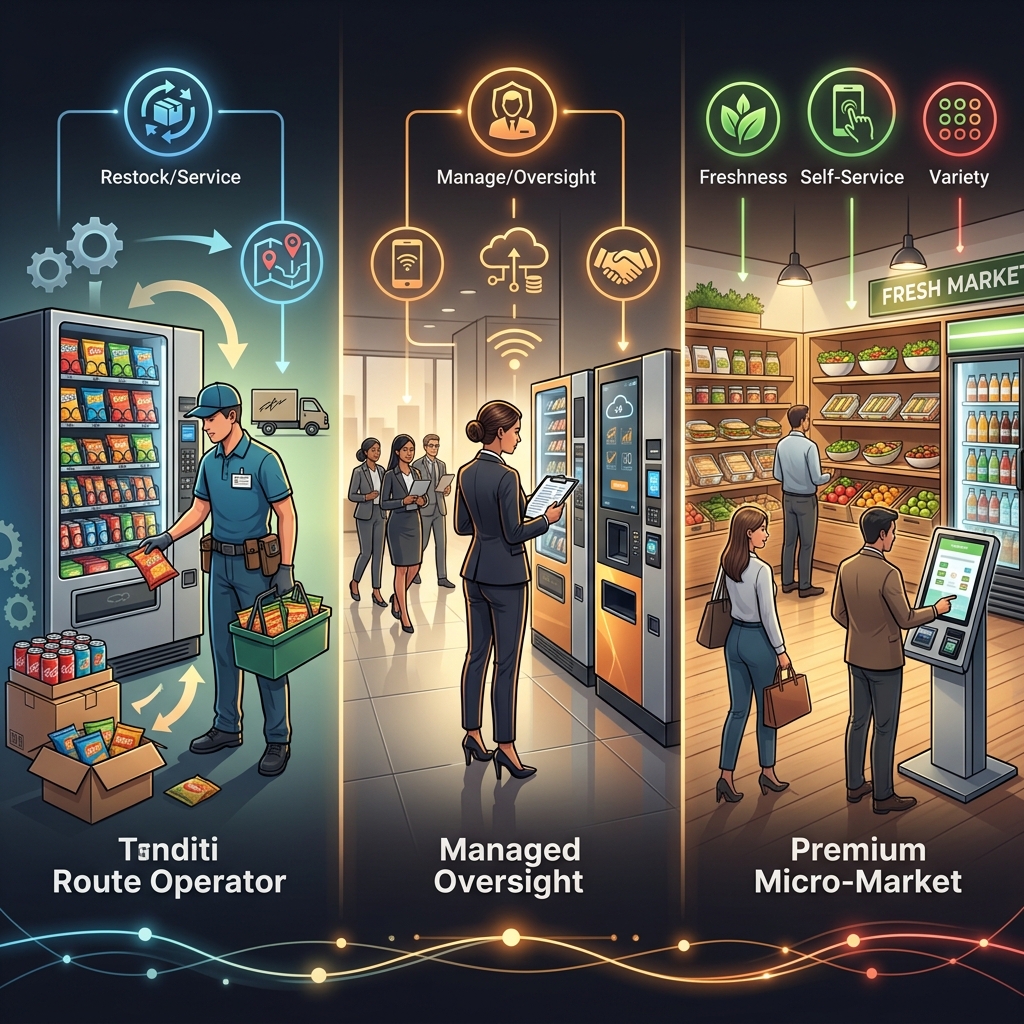
Three proven vending business models: Traditional Route Operating, Managed Vending, and Premium Micro-Markets.
Business Models & Revenue Streams: Choosing Your Vending Strategy
Before buying your first machine, you must choose your business model. The way you structure your operations, negotiate with property managers, and select products will dictate your startup costs, profit margins, and long-term business value. This lesson details the four primary business models, compares them in a dense reference table, and walks through the math of a typical office placement.
1. Traditional Vending (Owner-Operated)
In this model, you buy the machine, stock it with inventory you purchase at wholesale clubs, and place it in a location. You keep 100% of the sales revenue. In exchange, you provide free, reliable snack and beverage services to the location's employees and visitors.
- Scenario: You place a refurbished AMS Combo machine in a warehouse breakroom. You purchase cans of Pepsi for $0.42 and sell them for $1.25. You purchase bags of Lays for $0.48 and sell them for $1.50. You visit weekly to restock.
- Key Metric: You target a 60%+ gross margin and pay no commission to the business owner because their staff is small (under 100 people).
2. Managed Vending (Commission-Based)
For large, competitive, high-volume placements (like hospitals, universities, or factories with 200+ employees), property managers will demand a commission in exchange for exclusive rights to place machines on their property.
- Scenario: You secure a contract with a 250-employee distribution center. To win the account over national competitors, you agree to pay the business 10% of gross monthly sales, paid quarterly.
- Negotiation Range: Commission rates typically range from 5% to 15% of gross sales. You should only pay commission if the location generates at least $800/month in sales. Never pay commission on low-traffic accounts.
3. Micro-Markets: The Premium Unattended Retail Model
Micro-markets replace traditional vending machines with open shelves, glass-front reach-in coolers, and an automated checkout kiosk. They are ideal for secure office buildings or closed employee environments with 100+ daily workers.
- Scenario: You install a micro-market layout in a corporate tech office with 120 employees. The setup costs $7,500 (cooler, shelving, kiosk). Because customers can inspect salads, wraps, and premium drinks, the average transaction value is $4.50 (vs $1.50 in a machine), generating $3,000/month in sales.
- Risk Profile: Higher risk of theft (shrinkage) since products are accessible, but offset by significantly higher profit margins and volume.
- Shrinkage Management: Operators manage theft by putting up clear signage indicating security cameras are recording. Most VMS platforms integrate with security cameras to cross-reference transactions with video feeds. A typical micro-market experiences 2% to 4% shrinkage, which is easily offset by the higher product volume and margins.
4. Healthy / Specialty Vending
This model focuses on premium, organic, or niche products (like vegan snacks, kombucha, energy waters, or gluten-free bars) placed in gyms, luxury apartment complexes, or high-end office buildings.
- Scenario: You place a sleek, modern machine with a touch-screen interface in a premium health club. You stock Celsius energy drinks, Quest bars, and coconut water.
- Margin Profile: Because wellness consumers are less price-sensitive, you can sell energy drinks for $3.50 (cost: $1.45) and protein bars for $3.75 (cost: $1.35), commanding premium pricing.
5. Office Coffee Services (OCS) and Specialty P&L
Many operators expand their business by offering Office Coffee Services (OCS) or specialty vending machine configurations.
Office Coffee Services (OCS)
Instead of a vending machine, you place a commercial bean-to-cup coffee machine in an office.
- Revenue Model: The company pays you a flat fee per month (subsidy) or pays per cup dispensed. A typical business with 80 employees will pay $300-$500/month for coffee beans, cups, stirrers, creamer, and machine rental.
- OCS Economics:
- Wholesale cost of one premium coffee cup (beans, milk powder, cup, lid): $0.28
- Average price charged to employer (or employee): $1.50
- Gross Margin: 81.3%
- Monthly Volume: 400 cups
- Monthly Net Profit: $488.00 from a single countertop unit.
Specialty Vending (PPE and Electronics)
Specialty vending involves placing custom coils to dispense non-food items.
- PPE Vending: Placing safety glasses, gloves, earplugs, and vests in manufacturing facilities. The employer pays you a monthly fee to run the system, or employees swipe company badge cards to dispense gear (tracked by telemetry).
- Electronics Vending: Placements in airports or college lobbies. Hardware costs are high ($8,000+ for high-security locker machines), but items like charging cables (cost: $2.00, sell: $15.00) command 85%+ gross margins.
Business Model Comparison Matrix
| Business Model | Startup Cost | Avg. Gross Margin | Time Commitment | Operational Difficulty | Target Placements |
|---|---|---|---|---|---|
| Traditional Vending | Low ($2,000-$3,500) | 58% - 66% | Low (1-2 hrs/week) | Easy | Offices, Dealerships, Warehouses |
| Managed Vending | Med ($3,000-$5,000) | 48% - 55% (post-comm) | Med (2-3 hrs/week) | Moderate | Factories, Large Schools, Transit |
| Micro-Markets | High ($6,000-$10,000) | 60% - 70% | High (3-4 hrs/week) | Complex | Offices (100+ staff), Call Centers |
| Healthy/Specialty | Med ($4,000-$6,000) | 62% - 72% | Low (1-2 hrs/week) | Easy | Gyms, Universities, Luxury Condos |
Real Math: The 3-Machine Office Cluster P&L Scenario
To see how these numbers translate to your bank account, consider this hypothetical scenario. You have successfully placed 3 combo machines in three local office complexes, each housing approximately 60 employees.
- Total Monthly Revenue: $1,800 ($600 per machine average)
- Direct Inventory Cost (COGS at 40%): $720
- Gross Profit: $1,080
- Operational Expenses:
- Cashless reader monthly connection fees (3 x $9.95): $29.85
- Payment processing fees (5.9% of $1,800): $106.20
- Route fuel (estimated): $60.00
- General liability insurance allocation: $35.00
- Total Expenses: $231.05
- Net Operating Income (NOI): $848.95 per month
- Annualized Cash Flow: $10,187.40 from just three part-time machines.
Commission Structures and How to Negotiate Them
If a location manager requests a commission, use these rules to protect your profit:
- Request a Trial Period: State that commissions will be evaluated after a 90-day trial period to ensure the volume justifies it.
- Tiered Commissions: Offer a sliding scale. E.g., 0% commission on sales under $500/month, 5% on sales from $501-$1,000, and 10% on sales exceeding $1,000.
- Deduct Processing Fees: Ensure the contract states that commissions are calculated on net sales after deducting credit card processing fees (5-6%) and sales taxes.
Sourcing Your Inventory: SAMs vs. Wholesalers
Where you buy your stock dictates your cost of goods sold (COGS):
- Warehouse Clubs (Costco, Sam's Club, BJ's): Recommended for operators with under 10 machines. You pay no shipping fees, can inspect product expiration dates in person, and buy exactly what you need. COGS averages 40-45% of retail price.
- Broadline Distributors (Vistar, McLane): Sourced by operators with 15+ machines. They deliver directly to your warehouse space and offer bulk discounts. COGS averages 35-40%, but they require strict minimum orders ($1,000+ per delivery).
- Direct Store Delivery (DSD): For soda, Coca-Cola and Pepsi distributors will deliver directly to your high-volume machines if you meet their high-volume criteria. However, their pricing is often higher than buying cans in bulk at Sam's Club unless you buy full pallets.
Setting Vending Retail Prices
Use a target margin multiplier to set your retail pricing:
- Snacks: Target a 3x multiplier (300% markup). If a chip bag costs $0.50 wholesale, retail it for $1.50.
- Beverages (Cans): Target a 2.5x to 3x multiplier. If a soda can costs $0.42 wholesale, retail it for $1.25.
- Beverages (Bottles): Target a 2x multiplier. If a 20oz bottle costs $1.00 wholesale, retail it for $2.00.
- Energy Drinks & Protein: Target a 2.2x multiplier. If a Celsius costs $1.45 wholesale, retail it for $3.25.