Startup Costs & ROI Analysis
⏱ 7 min read
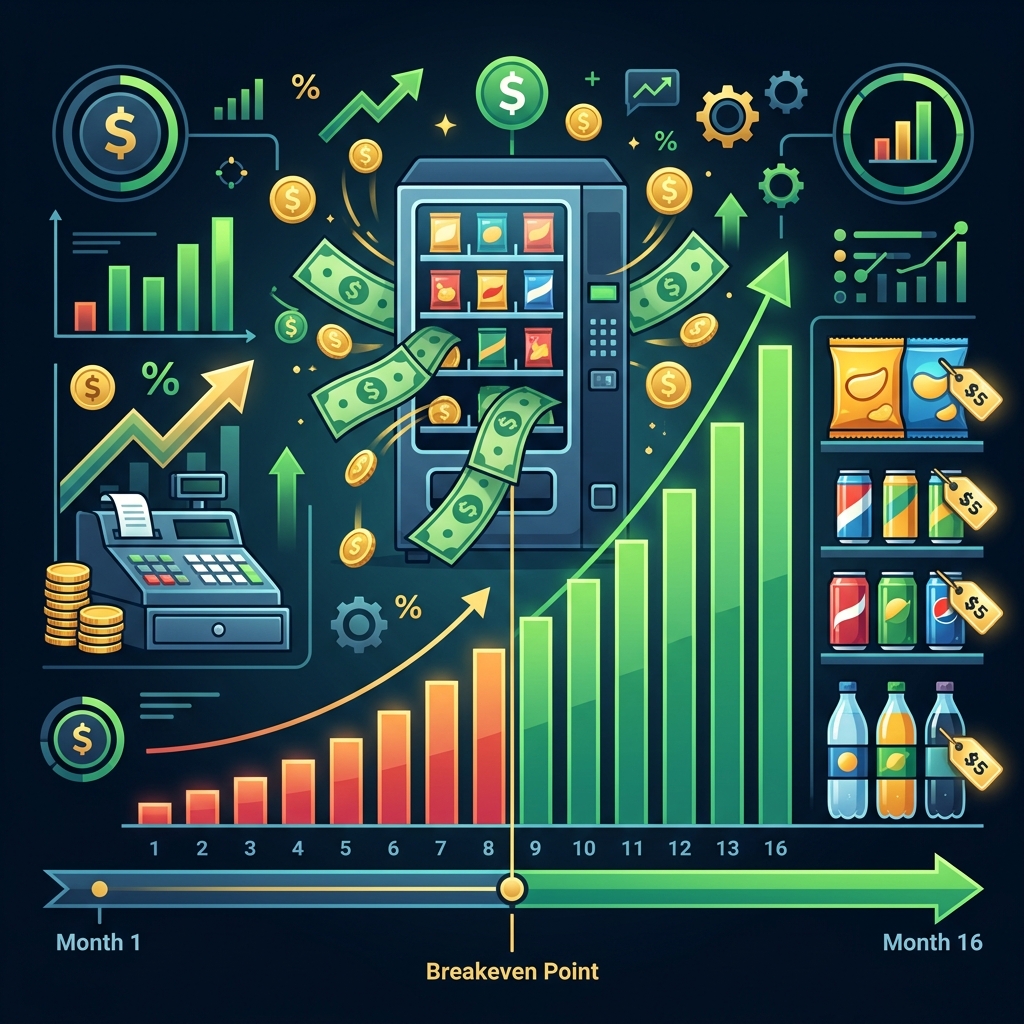
ROI timeline from Month 1 to breakeven, showing how a single vending machine compounds into monthly cash flow.
Startup Costs & ROI Analysis: Your First 90 Days Financial Roadmap
Starting a vending machine business is capital-efficient compared to other retail or service models, but it is not free. If you do not account for hidden fees, insurance, inventory, and initial cash flow, you will run out of cash before your machines start generating steady revenue. This lesson details your week-by-week financial timeline, breaks down three setup budget scenarios, and provides a comprehensive breakeven guide.
1. Week-by-Week Financial Timeline: The First 90 Days
- Weeks 1-2: Establish your LLC ($100-$300 depending on state), secure your federal EIN (free), and open a dedicated business checking account. Do not spend a penny on machines yet.
- Weeks 3-4: Scout locations. Secure your first signed Location Agreement. Never buy a machine before you have a signed contract for its placement. If you buy a machine first, you will pay storage fees while it sits idle in your garage.
- Weeks 5-6: Purchase your machine based on the location's footprint. Order a Nayax or Cantaloupe cashless reader.
- Weeks 7-8: Coordinate delivery. Install the machine, set up cashless payments, clean the cabinet, and allow the compressor oil to settle for 24 hours. Load initial inventory.
- Weeks 9-12: Monitor daily sales on your telemetry dashboard. Restock weekly. Collect your first month of profits.
2. Three Vending Startup Scenarios
To help you plan, review these three startup budget blueprints:
Scenario A: The Bootstrapper ($2,000 - $3,500 Budget)
Designed for part-time operators launching their first machine with minimal capital.
- Machine: Refurbished snack or beverage-only unit from a local dealer or Facebook Marketplace: $1,500 - $2,200
- Cashless Reader: Nayax VPOS Touch reader and harness: $350
- Initial Inventory: Sourced from Sam's Club/Costco: $250
- Business Setup: LLC filing fees and general liability insurance (first year): $400
- Transportation: DIY delivery using a rented pickup truck with a liftgate: $100
- Total Initial Outlay: $2,600 - $3,300
Scenario B: The Professional ($5,000 - $8,000 Budget)
Designed for operators targeting premium office locations that require modern combo machines.
- Machine: Certified refurbished AMS combo machine with drop sensors: $3,500 - $4,500
- Cashless Reader: Integrated Nayax reader: $350
- Initial Inventory: Extended initial product run: $400
- Business Setup: Full LLC formation, local licenses, and general liability insurance: $500
- Transportation: Professional "White Glove" delivery and leveling service: $350
- Total Initial Outlay: $5,100 - $6,100
Scenario C: The Enterprise ($15,000+ Budget)
Designed for operators launching a 3 to 5-machine route simultaneously to establish immediate route density.
- Machines: 4 refurbished combo and beverage machines: $11,500
- Cashless Readers: 4 Nayax readers: $1,400
- Initial Inventory: Bulk purchase: $1,200
- Business Setup: LLC, CPA consultation, licenses: $700
- Logistics: Professional multi-site delivery: $1,000
- Total Initial Outlay: $15,800
3. General Liability Insurance: Cost and Coverage
Do not skip insurance. Property managers will require a Certificate of Insurance (COI) naming them as additionally insured before they allow you to bring a machine onto their premises.
- Why You Need It:
- Property Damage: If your machine leaks cooling fluids and damages the office breakroom carpet.
- Bodily Injury: If a customer tips the machine over or claims they cut their hand on the delivery flap.
- Product Liability: If a customer gets food poisoning from an expired sandwich or drink sold in your machine.
- Cost: A typical $1M/$2M commercial liability policy for a starting vending operator costs $45 to $65 per month ($500-$750 annually). Companies like Hiscox, NEXT Insurance, and Progressive Commercial specialize in these micro-business policies.
4. Route Vehicle Economics
As you scale, transporting heavy inventory requires careful budgeting:
- Personal Hatchback/SUV (1-5 machines): Low startup cost, but high suspension wear. Depreciates your personal vehicle rapidly. Expect fuel costs of $15-$20 per route run.
- Mid-Sized Cargo Van (5-15 machines): Used Chevy Express or Ford Econoline van. Hardware costs are $5,000-$10,000. Cargo vans are heavy and get poor gas mileage (12-15 mpg). Set aside $40-$60 per route day for fuel, plus maintenance.
- Insurance for commercial vans: Commercial auto policies cost $120-$180 per month, which must be accounted for in your overall business overhead.
5. LLC Filing Fees and Tax Compliance
Establishing a legal business structure protects your personal assets (your house, car, personal savings) from business liabilities.
- LLC Formation Costs: LLC state filing fees vary dramatically. In Wyoming or New Mexico, it is under $100. In California, you must pay a $800 annual franchise tax regardless of your revenue. Delaware is $300/year.
- EIN (Employer Identification Number): Get this directly from the IRS website for free. Do not pay third-party registration websites to do it.
- Sales Tax Registration: Most states charge sales tax on food and beverages sold via vending machines. You must register for a state Sales Tax Permit and file returns quarterly or annually. VMS systems like Nayax automate sales tax reporting by generating reports detailing exactly what was sold in each city/county, enabling rapid tax filing.
6. SBA Microloans and Equipment Leasing Options
If you need financing to scale, two primary structures exist: SBA microloans and commercial equipment leasing.
SBA Microloans
- Terms: Loans up to $50,000 with interest rates typically between 6% and 9% and repayment terms up to 6 years.
- Key Eligibility Requirements:
- Credit Score: Lenders look for a credit score of 680 or higher.
- Equity Contribution: You must show a down payment of 10% to 20% of the loan amount in cash.
- Collateral: The vending machines themselves are pledged as collateral, but lenders may also require personal guarantees or liens on personal vehicles.
- Business Plan: A professional, detailed plan showing signed locations is required.
Commercial Equipment Leasing
Leasing allows you to acquire machines from large distributors (like Vending.com) with low upfront costs.
- Fair Market Value (FMV) Lease: You pay lower monthly lease payments for a set term (e.g., 36 months). At the end of the term, you can purchase the machine for its current fair market value, extend the lease, or return it. This is ideal if you plan to upgrade to newer machines frequently.
- $1 Buyout Lease: Your monthly payments are slightly higher, but at the end of the term (e.g., 36 or 48 months), you purchase the equipment for exactly $1.00. This is generally the preferred option for vending operators because vending machines are durable assets with a long useful life of 10 to 15 years if properly maintained.
7. Detailed Breakeven and Payback Calculator
To find your breakeven point, calculate your Fixed Costs and Variable Cost Ratio.
- Fixed Costs (Monthly):
- Cashless reader subscription: $9.95
- Business insurance allocation: $50.00
- LLC franchise tax allocation: $20.00
- Route fuel allocation: $30.00
- Total Monthly Fixed Costs = $109.95
- Variable Cost Ratio:
- Cost of Goods Sold (COGS): 40%
- Cashless processing fees: 6%
- Spoilage rate: 4%
- Total Variable Cost Ratio = 50%
- Contribution Margin = 50% (100% - 50%)
Breakeven Formula
This means your machine must generate at least $219.90 per month ($7.33 per day) in sales to cover its own costs. Any sale above this amount generates a 50% profit margin directly to your pocket.